
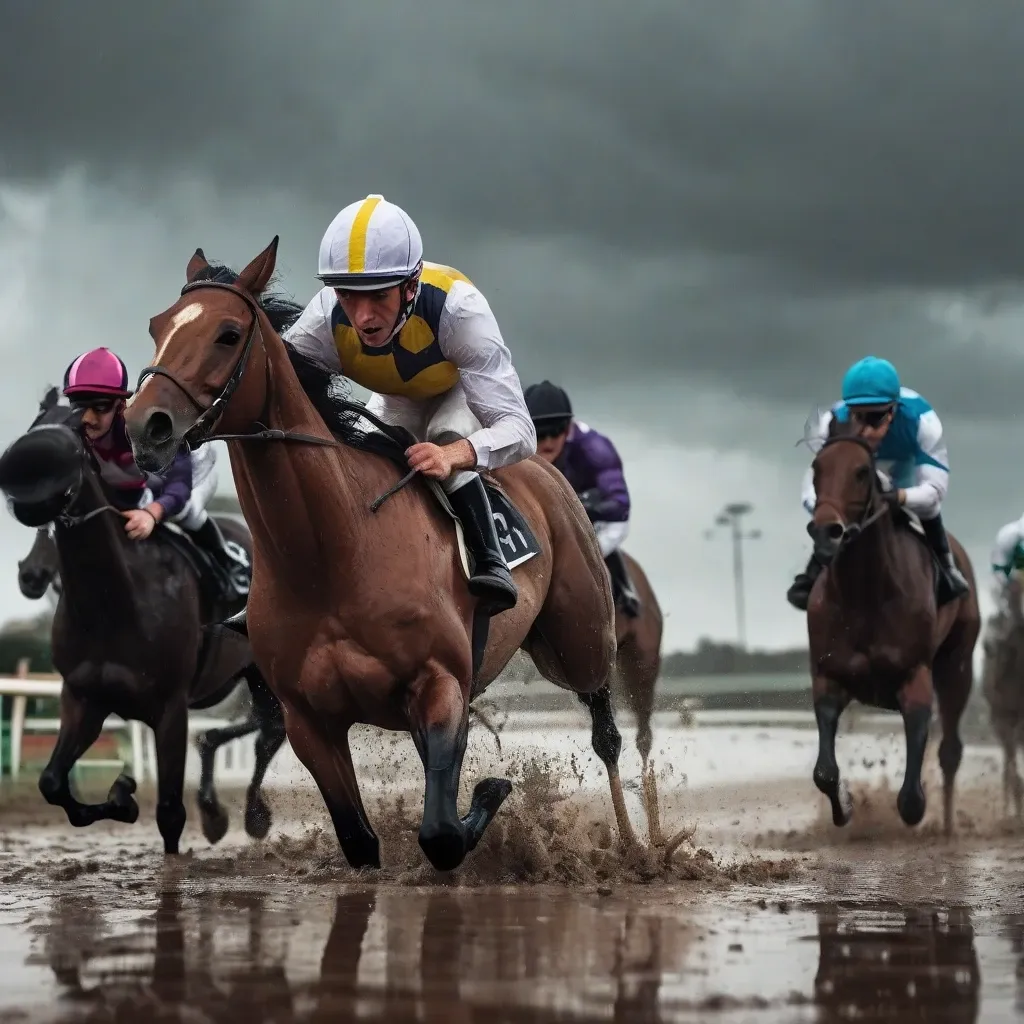
Mud transforms a horse race from a test of pure speed into a grueling battle of stamina and adaptability. On a fast, firm track, horses can unleash their full power, their hooves meeting a solid surface that allows for maximum traction and efficient energy transfer. Each stride propels them forward with minimal wasted effort.
Introduce mud, however, and the equation changes dramatically. The once-reliable footing becomes treacherous. Each step now requires significantly more effort as the horse’s hooves sink into the soft, yielding surface. Think of it like running on a beach, the deeper the sand, the more energy is required to move forward. Muddy conditions compromise traction and force horses to work harder to maintain their speed and balance.
Studies on equine biomechanics have demonstrated how mud impacts a horse’s stride. The length of the stride shortens. The effort required to lift the leg increases substantially. This extra energy expenditure takes a toll, favoring horses with superior stamina and those who can navigate the sloppy track with greater efficiency. The ability to maintain momentum and conserve energy becomes paramount when the track turns to mud.
Identifying Horses Vulnerable to Mud
Not all equine athletes are created equal, especially when the track turns to slop. In the unpredictable world of horse racing, a muddy track can dramatically level the playing field – or bury certain contenders altogether. Understanding which horses are predisposed to struggling in the mud is crucial for informed handicapping. Several factors contribute to a horse’s vulnerability on an off-track, including racing style, pedigree, and physical attributes. Some competitors seem to relish the challenge, powering through the muck with ease, while others find their speed and stamina significantly compromised.
Deep closers, for example, horses that prefer to lag behind the pack before unleashing a final burst of speed, often find themselves at a distinct disadvantage in muddy conditions. The sloppy surface can hinder their ability to gain ground, and the increased effort required to navigate the wet track can diminish their closing kick. Pedigree also plays a surprising role. Certain bloodlines are notorious for producing horses that simply don’t care for running on anything other than a fast, dry surface. While not an exact science, examining a horse’s lineage can offer clues about its potential mud tolerance. Further, a horse’s action, or the way it moves, is crucial. Many horses are known for high-knee action, which is a disadvantage that can lead to fatigue in the mud.
Spotting these vulnerable horses is a mix of art and science. It involves carefully analyzing past performances, observing their physical characteristics, and understanding the nuances of different racing styles. Paying attention to these can help you avoid backing a horse doomed to wallow in the slop.
Conformation and Action: What to Look For
A horse’s physical build, or conformation, can significantly influence its ability to handle a muddy track. A horse with a more upright shoulder angle, for instance, might struggle to extend its stride and maintain its balance in the slippery conditions. Conversely, horses with a sloping shoulder tend to have a smoother gait that helps them handle any running conditions. This is closely tied to action; short, choppy strides are a red flag.
Observing video replays of past races, when available, offers invaluable insights. Does the horse appear to be struggling to find its footing? Is it lacking in fluidity and balance? These visual cues can be just as telling as any statistical data. Also, reviewing the same horse’s or similar horse’s races to look for the same deficiencies can be helpful.
Spotting Mud-Loving Champions
Unlocking the secrets to identifying horses that thrive in muddy conditions can significantly improve your horse racing insights. Look beyond just the horse’s overall record; delve into how they perform when the track isn’t fast. A true mud-loving horse possesses specific traits – a powerful, efficient stride to cut through the softened ground, and the stamina to maintain speed when others falter. Their racing style often involves getting to the front early or stalking closely, as they handle the kickback of mud better than deep closers. Physically, these horses often exhibit strong, muscular builds, enabling them to navigate the demanding surface.
Pedigree plays a crucial role. Certain bloodlines have a proven history of producing horses that excel on off-tracks. Research the sires and dams of potential contenders, looking for ancestors known for their success in the slop. While a strong pedigree is no guarantee, it certainly increases the odds. Some famous examples of mud-loving horses showcased a relentless spirit and an adaptability to any surface. Their victories in adverse conditions weren’t due to luck but to a combination of inherent talent, suitable physique, and a pedigree that predisposed them to conquer the mud.
Analyzing Past Performances: The Clues in the Form
The past performance record, or “form,” is a treasure trove of information when searching for mud runners. Don’t just glance at the overall win percentage; scrutinize races run on wet tracks. Look for horses that consistently improve their speed figures on muddy surfaces compared to dry tracks. A horse might have mediocre speed figures overall, but a significant jump in speed when racing on an off-track is a major indicator. Also, pay attention to how the horse finished in those races. Did they fade in the stretch, or did they maintain their position, or even surge ahead?
However, be cautious when relying solely on speed figures. The track condition significantly impacts these figures; a slow, muddy track will naturally produce slower times. Therefore, it’s crucial to compare speed figures from races run on similar surfaces. Consistency is key. A horse that consistently performs well on muddy tracks, even if their speed figures aren’t stellar, is a more reliable mud runner than a horse with one exceptional race on an off-track. Look at other horses form to compare each other and see if the horse performed better compared to its opponents with similar rating.

Adjusting Your Betting Strategy for Muddy Tracks
When the skies open and the track turns to mud, the form book often goes out the window. Successful horse racing bettors understand that adapting their strategy for a muddy track is crucial for finding value and capitalizing on opportunities that fair-weather fans overlook. Mud drastically alters a horse’s performance, making it essential to reassess your approach.
One key element is identifying overlays and underlays. An overlay is a horse whose odds are higher than its actual chance of winning, considering the muddy conditions. Conversely, an underlay has odds lower than its true probability. Mud-loving horses, often overlooked, frequently become overlays on a sloppy track. Analyze past performances on similar track conditions to pinpoint these potential value bets. Public perception often lags behind reality, leading to inflated odds on horses with poor mud pedigree and deflated odds on those that thrive in it.
Exotic wagers like exactas and trifectas also demand adjustment. Instead of blindly sticking with the favorites, incorporate horses known for their affinity for the slop. A horse that consistently finishes mid-pack on a fast track might transform into a contender on a muddy one. Conversely, vulnerable favorites, particularly those with questionable breeding for off-track conditions, should be excluded. Research breeding lines, looking for sires and dams that consistently produce mud runners.
Ultimately, betting on horse racing, especially on a muddy track, requires a keen understanding of both the horse’s capabilities and the betting public’s biases. By identifying overlays, adjusting exotic wagers, and understanding how the mud impacts performance, bettors can gain a significant edge and increase their chances of landing profitable value bets.
The “Bounce” Factor: Regression After Racing in the Mud
In the world of horse racing, predicting a winner involves more than just analyzing past performances; it requires understanding the nuances of how different track conditions affect each horse. One crucial factor is the “bounce” – the tendency for a horse to regress in its next race after a particularly strenuous effort. This phenomenon is often amplified when the previous race was run on a sloppy or muddy track. After a difficult race on a muddy track a horse is likely to show that they haven’t properly recovered in their next race.
Why is mud such a significant contributor to post-race regression? Mud extracts stamina, and can cause exhaustion. Each stride requires more effort, and increases the risk of injury. This heightened exertion leads to greater fatigue and stress on the horse’s musculoskeletal system. The deep, inconsistent footing increases the chance of strains, sprains, and other minor injuries that might not be immediately apparent but can hinder performance in the subsequent race.
Identifying horses vulnerable to the bounce requires careful observation. Look for those that visibly struggled in the mud, finishing far behind their usual pace or showing signs of distress. Analyze their running style; horses that prefer firm ground may be particularly disadvantaged by a muddy track. Consider their past performance after similar races on similar track conditions. If a horse has consistently bounced after running in the mud, it’s a strong indicator that it will do so again. Recognizing this vulnerability can create profitable betting opportunities. For instance, remember the case of “Mudlark’s Misery” at Churchill Downs? After slogging through a particularly heavy track and finishing a distant eighth, the horse was largely dismissed in its next race. But an astute observer realized that her poor performance was more a reflection of the track conditions than a true indication of her ability. A well-timed bet on Mudlark’s Misery in the subsequent race, resulted in a substantial payout, highlighting the value of understanding the “bounce” factor.
Case Studies: Mud Races Where Favorites Falters
Horse racing history is filled with instances where highly favored horses stumbled in the mud, turning expected victories into shocking upsets. Examining these case studies offers invaluable lessons for bettors and racing enthusiasts alike.
Consider the example of “Starlight Express” at the Churchill Downs Spring Meet in 2018. This horse entered the race as the clear favorite, boasting a series of wins on fast tracks. However, an unexpected downpour transformed the track into a muddy quagmire. “Starlight Express,” seemingly unable to gain traction, finished a distant seventh. In contrast, “Mudlark,” a horse with a proven track record in wet conditions and longer odds, surged to victory. Betting market overlooked “Mudlark’s” specific advantage of racing in mud.
Another notable case is “Golden Boy’s” defeat at Saratoga in 2021. Coming off two impressive wins, “Golden Boy” was heavily backed by the public. The Saratoga track, however, was sloppy due to persistent rain. “Golden Boy,” a speed horse known for its early pace, struggled to maintain its lead, eventually fading in the stretch. The race was won by “Grit and Grind,” a closer with a grinding running style and a demonstrated ability to handle adverse track conditions. The upset underscored the importance of considering a horse’s running style and stamina when assessing its chances in the mud.
These case studies highlight that a horse’s performance on a fast track is not always indicative of its ability to perform well in the mud. Factors such as breeding, conformation, and running style play a significant role. Analyzing past performance data with a focus on mud races, and also recognizing the traits of successful mud runners, can provide valuable insights and potentially lead to profitable betting decisions, even when favorites falter.
Conclusion
Mastering the art of handicapping horse races in muddy conditions can significantly boost your chances of winning. By understanding how different factors, like a horse’s pedigree and past performances on similar tracks, impact their performance, you’re already ahead of the game. So, next time the skies open up, don’t shy away from the challenge. Embrace the mud, apply these strategies, and watch your betting success soar. Remember, the track conditions are a crucial piece of the puzzle – use them to your advantage!